Mighty Heart: A Font That Adds Elegance to Every Design
It’s a typical Monday morning, and I’m sitting at my desk with a fresh brand board open in front of me. The client is a small boutique that sells handmade jewelry and accessories. Their vision is simple but elegant—something that feels personal, artistic, and timeless. As I start sketching out logo ideas, I find myself thinking about the right font to bring their brand to life. That’s when I pull up Mighty Heart.
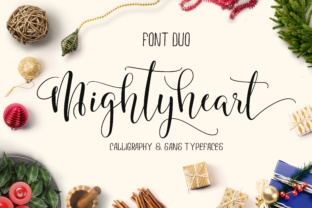
Mighty Heart is a highly stylized, swashy calligraphic font that immediately catches my eye. It has that classic script feel with a modern twist. The swashes are bold and expressive, giving it a sense of movement and flair. It’s not too ornate, which makes it versatile for different design applications. I like how it balances elegance with readability, making it a great choice for both display and body text.
The First Mockup: Testing the Font in Action
I started by testing Mighty Heart on a few logo drafts. The first one was a simple monogram with the boutique’s name in all caps. Mighty Heart worked beautifully—it added a touch of sophistication without overwhelming the design. I also tried using it in lowercase for a more casual look, and it still felt refined.
One thing I noticed right away is how well Mighty Heart handles spacing and flow. The serifs are subtle but present, giving it a handcrafted feel. It’s not the kind of font that screams “I’m fancy,” but it definitely has a personality. That’s what makes it so appealing for branding projects where you want to convey warmth and authenticity.
Branding with Mighty Heart: From Logo to Brand Identity
As I developed the brand identity, I used Mighty Heart in several key areas. For the logo, I paired it with a clean sans serif font to create contrast and balance. The combination worked well, allowing the script to stand out while keeping the overall design grounded.
For packaging and product labels, I experimented with different weights and styles of Mighty Heart. The bold version was perfect for headlines and taglines, while the lighter weight was ideal for supporting text. I found that it looked great on business cards, signage, and even social media graphics. It’s a font that adapts well to various formats and mediums.
One of my favorite uses was on the homepage hero section of the boutique’s website. I used Mighty Heart as the headline font, and it added a nice visual punch without being distracting. It’s important to note that while Mighty Heart is a display font, it can also be used effectively in short-form text when paired with appropriate supporting typography.
Font Pairing: Finding the Right Companions
When working with a script font like Mighty Heart, it’s crucial to pair it wisely. I often use a sans serif font for body text to ensure readability. In this case, I went with a modern sans serif that complemented the elegance of Mighty Heart without clashing.
For editorial design or printed marketing materials, I considered using a serif font to add depth and texture. However, I found that Mighty Heart alone could carry the design effectively, especially when used sparingly. It’s a font that works best as a headline or accent typeface, rather than for long blocks of text.
I also tested Mighty Heart on a few different color backgrounds and found that it performs well in both dark and light environments. Its contrast and stroke weight make it adaptable to various design contexts, whether it’s a shop sign, a label sticker, or an Instagram post.
Design Observations: How Mighty Heart Impacts Perception
Throughout the project, I kept track of how Mighty Heart affected the brand’s perception. Clients and stakeholders consistently commented on its elegance and uniqueness. It helped set the boutique apart from competitors, creating a memorable brand identity.
Readability was another factor I considered carefully. While Mighty Heart is a display font, I made sure to use it in ways that maintained clarity. This meant avoiding overuse and ensuring that it was always supported by other typography elements. It’s a delicate balance, but one that pays off in the end.
Consistency was key in the final brand system. I made sure that Mighty Heart was used consistently across all materials, from packaging to digital assets. This helped reinforce brand recognition and created a cohesive visual language that resonated with the target audience.
Practical Advice: Testing Before Committing
If you’re considering using Mighty Heart for your next project, I recommend testing it early in the design process. Start by applying it to mockups and see how it looks in different contexts. Pay attention to how it interacts with other design elements and how it affects the overall mood of the project.
Also, don’t forget to check the included styles and alternates. Mighty Heart offers a range of weights and ligatures that can enhance your design. It’s also worth checking if it supports multilingual characters, which can be useful for international clients or businesses with diverse audiences.
Finally, make sure you understand the licensing terms. Since it’s a commercial font, you’ll need to ensure that it’s appropriate for your intended use. There are many great options available, and Mighty Heart is one that stands out for its versatility and elegance.
Overall, Mighty Heart is a font that adds a unique touch to any design. Whether you’re working on a logo, packaging, or digital assets, it has the potential to elevate your work and create a lasting impression. It’s a great addition to any designer’s toolkit, especially for those who value both style and functionality in their typography choices.